We read the cryptography before touching active volumes.
Akira affiliates exploit edge VPNs, Veeam infrastructure, and hypervisor management APIs across Windows, VMware ESXi, and Nutanix AHV. We isolate keystreams, carve raw VMDK/QCOW2 disk blocks, and sanitise backdoors without brokering ransoms.
.akira, .powerranges, .akiranew). Do not purge .arika checkpoint files—these contain internal synchronization offsets essential for surgical restoration.
Cryptographic Reversal. Zero Ransom Brokerage.
We operate strictly as an advanced digital forensics and incident response (DFIR) engineering unit. We do not negotiate or pay ransoms. Every engagement produces court-admissible evidence and fully validated data recovery.
Client Communications — Anonymised
Real post-engagement messages from clients whose environments were fully recovered. All personal information, phone numbers, and identifying details have been redacted prior to publication with client consent.
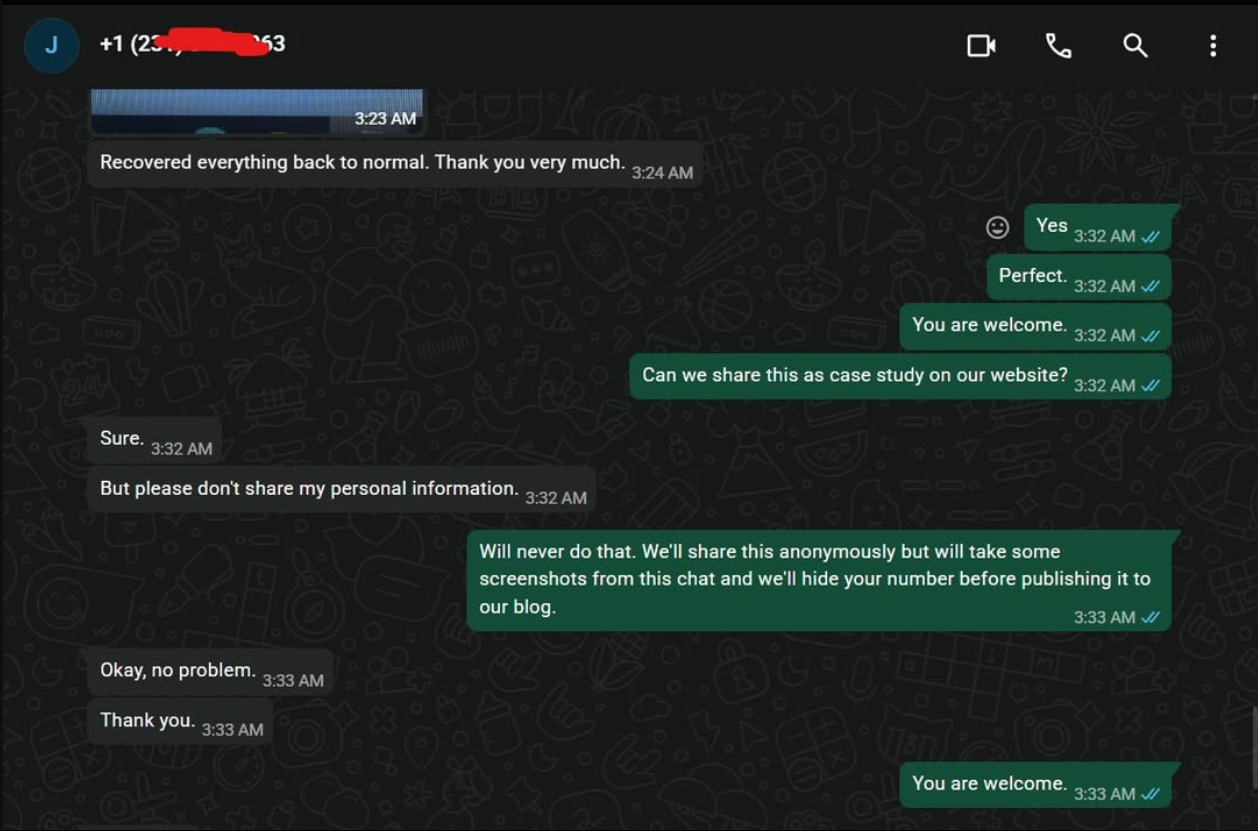
“Recovered everything back to normal. Thank you very much.”
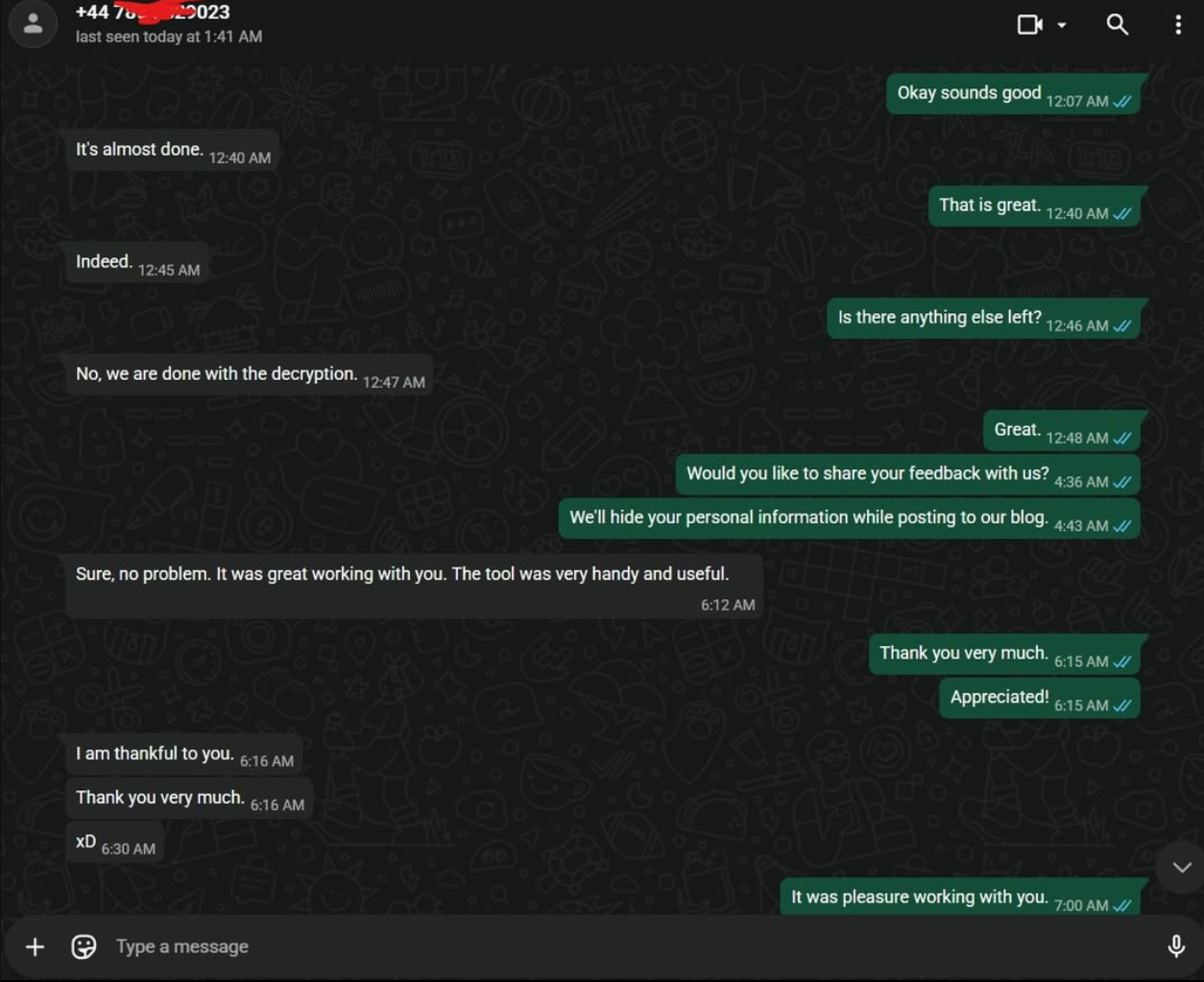
“No, we are done with the decryption. Thank you very much. Appreciated!”
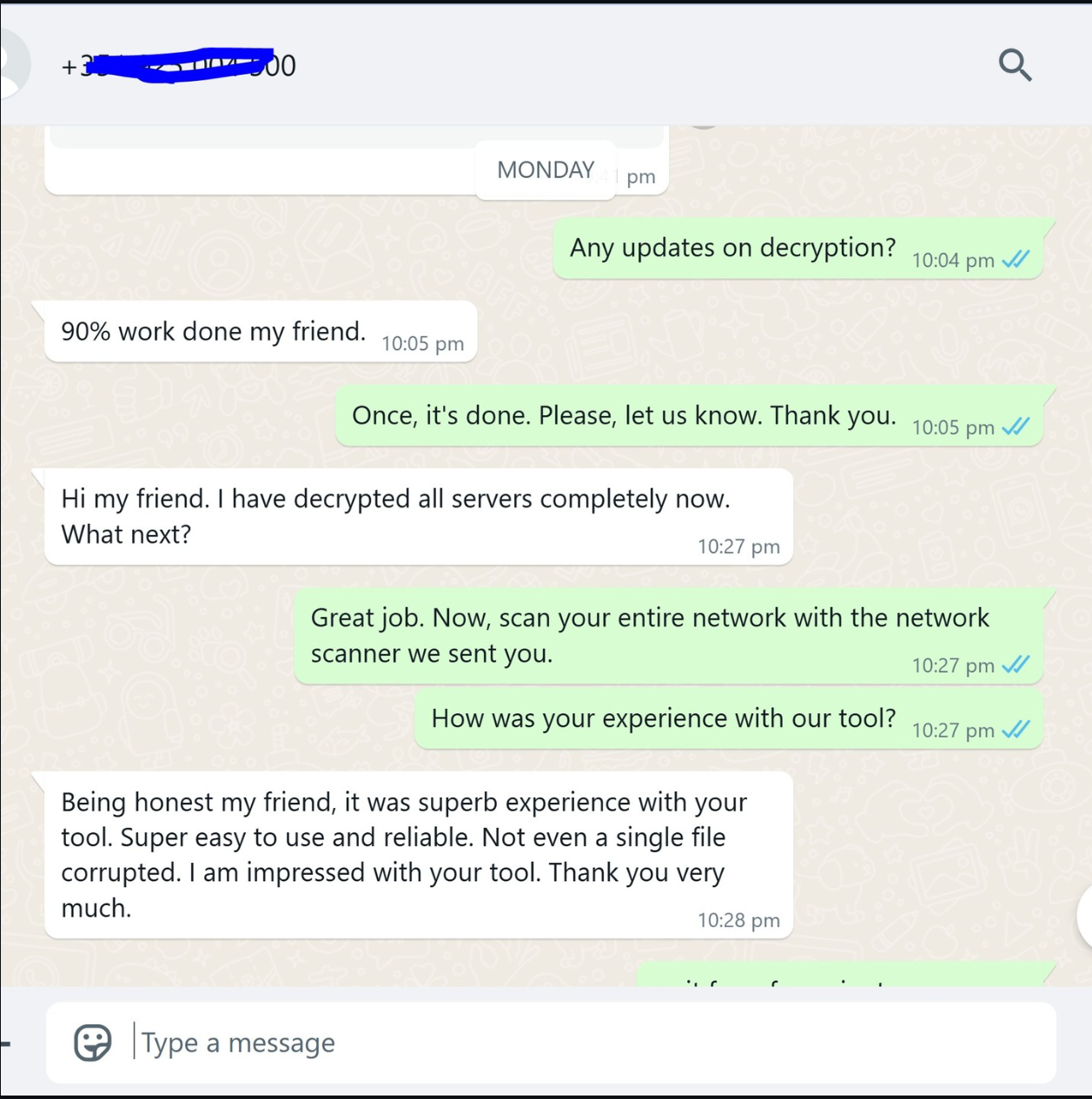
“Tool is very easy to use and reliable. We got the servers decrypted successfully.”
Industries Under Active Akira Targeting
Akira affiliates maintain active target lists across high-value sectors with known backup infrastructure gaps and VPN perimeter weaknesses.
Healthcare & Life Sciences
PACS imaging servers, EHR databases, and HIPAA-governed PHI repositories with strict downtime thresholds.
Construction & Engineering
Project management platforms, BIM models, and supply chain financial systems across multi-site operations.
Legal & Professional Services
Client-confidential document repositories, billing systems, and matter management databases.
Manufacturing & Supply Chain
ERP systems, SCADA interfaces, and JIT inventory databases where downtime cascades across partners.
Financial Services
Core banking ledgers, payment processing infrastructure, and regulatory reporting systems.
Education & Research
Student information systems, research datasets, and campus-wide Active Directory forests.
Local Government & Municipalities
Tax assessment databases, permitting systems, and public safety dispatch infrastructure.
Managed Service Providers
RMM tooling compromise enabling downstream client encryption across multi-tenant environments.
Recent Recovery Engagements
Anonymised summaries of recent Akira ransomware containment and recovery operations across diverse enterprise environments.
Regional Hospital Network — 3,200 Beds
Akira v2 Rust variant deployed via compromised Cisco ASA VPN. 480 VMs across three ESXi clusters encrypted. PHI exposure risk mitigated through immediate network segmentation.
Automotive Tier-1 Supplier — 14 Sites
ESXi ELF binary encrypted production ERP and MES systems across German and Czech facilities. Recovery via VMDK block carving and .arika offset mapping from preserved RAM dumps.
Magic Circle Law Firm — 2,400 Staff
SonicWall SSL-VPN exploitation led to domain-wide compromise. Veeam backup repository encrypted before exfiltration completed. Recovered via shadow copy reconstruction and NTFS journal carving.
Akira Attack Chain: Edge Exploitation to Hypervisor Destruction
Affiliates combine perimeter CVE weaponisation with direct hypervisor-level disk encryption to bypass endpoint telemetry. The full kill chain typically executes within 4–72 hours from initial access.
-
Perimeter IngressExploitation of vulnerabilities in SonicWall SonicOS (
CVE-2024-40766), Cisco AnyConnect/ASA SSL-VPNs (CVE-2020-3259,CVE-2023-20269), Fortinet FortiGate (CVE-2024-21762), and Veeam Backup instances (CVE-2023-27532/CVE-2024-40711) without MFA. Akira affiliates maintain automated scanners that probe for these vulnerabilities across internet-facing infrastructure 24/7. -
Hypervisor DisruptionExecuting batch
esxcliandvim-cmdcommands within hypervisor shells to kill virtual machines before encrypting raw disks (.vmdk,.qcow2). On ESXi 6.7–8.0, attackers exploit the unlocked SSH service (often left enabled for remote management) to upload and execute the Linux ELF binary directly on the host. -
Defense Evasion (BYOVD)Deploying Bring Your Own Vulnerable Driver (BYOVD) exploits with signed rootkit drivers (e.g., Zemana Antimalware, PowerTool CPU driver, DBUtil_2_3.sys) to terminate protected EDR agents from kernel space. This technique bypasses user-mode protections entirely and has been observed against CrowdStrike, SentinelOne, and Defender for Endpoint.
-
Dual-Use C2 IngressDeploying legitimate remote software—including Ngrok, AnyDesk, RustDesk, ScreenConnect, and Cloudflare Tunnels—to maintain out-of-band egress channels that blend with normal administrative traffic. These tools are often pre-staged during the reconnaissance phase and activated only when primary C2 is disrupted.
-
Active Directory ReconExecuting
SharpDomainSpray, Mimikatz, ADFind, BloodHound, andnet.exeto harvest Kerberos tickets, enumerate Group Policy Objects, and compromise domain controllers rapidly. Attackers typically achieve Domain Admin privileges within 2–6 hours of obtaining initial foothold. -
Backup Infrastructure TargetingSystematic identification and destruction of Veeam Backup & Replication servers, Commvault backup repositories, and NAS-based backup targets. Akira operators specifically search for
VeeamBackupservice accounts and use stolen credentials to delete backup chains before encryption begins, eliminating the primary recovery path for most organizations.
Typical Akira Intrusion Timeline
Based on forensic analysis of 50+ engagements, this represents the median attack progression from initial access to full encryption. Variance of ±60% exists depending on network complexity and EDR posture.
VPN Exploitation & Shell Access
Affiliate exploits CVE on internet-facing SSL-VPN appliance, obtains reverse shell or authenticated session, and drops initial staging payloads into %TEMP% or /tmp.
C2 Establishment & Network Mapping
Deploying Ngrok/AnyDesk tunnels, executing AD enumeration tools, and identifying backup infrastructure locations. Scheduled tasks and registry run keys established for persistence.
Credential Harvesting & Domain Compromise
LSASS dumping via Mimikatz or direct procdump, Kerberoasting service accounts, and lateral movement via RDP with stolen credentials. Domain Admin typically achieved within this window.
Data Staging & Cloud Upload
High-value databases, document repositories, and credential stores archived with 7-Zip and uploaded via rclone to Mega, CloudMe, or attacker-controlled FTP servers. Exfiltration often exceeds 500GB.
Backup Chain Elimination
Veeam backup jobs stopped, VBK/VIB files deleted or encrypted, NAS backup snapshots destroyed. This is the critical window where organizations lose their primary recovery capability.
Intermittent Block Encryption Across All Targets
Windows PE32 and Linux ELF64 binaries deployed simultaneously across workstations, servers, and hypervisors. VMs killed via vim-cmd before raw disk encryption begins. Ransom notes dropped into every traversed directory.
Enterprise Tactics, Techniques & Procedures (TTPs)
Cross-referencing active Akira forensic artifacts with standard MITRE ATT&CK technique IDs. Mapping covers the full kill chain from initial access through data impact.
Exploit Public-Facing Application
Exploitation of SSL-VPN appliances and unpatched edge backup nodes. SonicWall, Cisco ASA, FortiGate, and Veeam are the four most-observed ingress vectors.
Valid Accounts & Scheduled Tasks
Creation of rogue service accounts, scheduled task persistence via schtasks, and Group Policy Object manipulation for long-term access.
PowerShell & Command Scripts
Executing batch commands to disable Defender, purge event logs via wevtutil cl, and terminate security services.
LSASS Memory Ingestion
Extracting cleartext credentials directly from memory via LSASS dumps using Mimikatz, Comsvcs.dll mini-dump, or direct process memory mapping.
Kerberoasting
Requesting Kerberos service tickets for accounts with SPNs and cracking them offline to obtain service account credentials for lateral movement.
RDP & Dual-Use Utilities
Pivoting across subnets using AnyDesk, RDP with stolen Domain Admin tokens, and WMI/PSExec for remote command execution.
Disable or Modify Security Tools
BYOVD driver deployment to kill EDR processes from kernel mode, SafeBoot registry manipulation, and tamper protection bypass via signed vulnerable drivers.
Cloud Staging & Egress
Staging archived databases to cloud storage via RClone targeting Mega.nz, pCloud, and attacker-operated FTP/WebDAV endpoints.
Intermittent Encryption
Fast-block intermittent encryption targeting databases and VM disks with configurable encryption percentages (typically 40–60%) to maximise disruption while minimising encryption time.
Engineering Toolchain & Methodology
Our recovery capability is built on a layered forensic toolchain spanning volatile memory acquisition through to hypervisor disk reconstruction.
Volatile Key Extraction
Using Magnet RAM Capture, WinPmem, and custom kernel-level keystream hunters to extract ChaCha8 symmetric keys from live RAM buffers before power state changes.
Block-Level Carving
Custom-built tools for parsing .arika offset markers, reconstructing VMDK descriptor files, and identifying unencrypted block ranges within intermittently-encrypted disk images.
Event Correlation Engine
Automated parsing of EVTX, VPN authentication logs, IIS W3C logs, and ESXi hostd.log files to reconstruct the complete intrusion timeline with sub-second accuracy.
Binary Disassembly
IDA Pro and Ghidra static analysis of PE32 and ELF64 ransomware binaries to identify cryptographic constants, PRNG seed values, and key derivation logic for custom decryptor development.
PCAP & DNS Forensics
Full PCAP reconstruction from network taps and Zeek/Suricata logs to identify C2 beaconing patterns, exfiltration endpoints, and data staging destinations.
Air-Gapped Testbeds
Recovered disk images and custom decryptors are validated inside isolated sandbox environments before any data is written to production storage, preventing secondary corruption.
Windows vs. Linux/ESXi Encryption Architectures
Akira deploys two distinct binary schemes across targeted enterprise workloads. Understanding the cryptographic differences is critical to determining recovery viability.
Windows Binary (PE32 / Rust)
Targets domain workstations and Windows Servers, suppressing Volume Shadow Copy Service before encryption begins.
- Cryptographic Cipher: ChaCha8 stream cipher via CryptoPP library, wrapped with RSA-4096 public key for per-file key encapsulation.
- Intermittent Pattern: Encrypts configurable block offsets (default: 400KB per 1MB) to evade I/O tripwires while maximising data destruction.
- Telemetry Suppression: Executes
vssadmin.exe delete shadows /all /quiet, disables Windows Defender viaSet-MpPreference -DisableRealtimeMonitoring $true, and clears EVTX logs. - Identifier Extension:
.akira(original),.powerranges(variant),.akiranew(current),.aki(emerging). - Thread Architecture: Multi-threaded encryption using Rust’s
std::threadwith configurable thread count via--forkflag. - Exclusion List: Skips
C:\Windows,Program Files, andProgram Files (x86)to maintain system bootability for ransom note display.
Linux / ESXi (POSIX ELF64)
Targets hypervisor storage pools directly via command-line execution arguments. No GUI component — purely headless operation.
- Cryptographic Cipher: POSIX-native ChaCha8 stream cipher implemented without external library dependencies.
- Process Termination: Automated
vim-cmd vmsvc/power.off [VMID]scripts enumerate and kill all running VMs before disk access. - Target Formats: Encrypts
-flat.vmdk,.vmdkdescriptor files,.qcow2, and backup repository flat files. - State Marker: Generates
.arikafile-state checkpoints containing thread offset sync data for resumable encryption. - CLI Parameters:
--fork N(threads),-n(dry run),--encryption_percent N(intermittent ratio),-p /path(target directory). - ESXi-Specific: Drops kill scripts to
/tmp/.esx_akira/and modifiesesx.confto disable vSphere HA and DRS before execution.
Decryptor Viability & Variant Breakdown
Evaluating public decryptor availability against custom engineering and block-carving workflows. Variant identification is the first step in any recovery engagement.
Akira v1 (C++ Build)
Early-to-mid 2023 variant using ChaCha20. Due to a cryptographic generation flaw reverse-engineered by Avast—where the PRNG was seeded with predictable values—files encrypted by pure v1 Windows samples can be decrypted using open-source utilities without paying a ransom. This variant represents approximately 15% of historical infections we have encountered.
Akira v2 / Megazord (Rust)
Deploys fixed ChaCha8/RSA-4096 crypto with no known mathematical weaknesses. Public decryptors cannot unlock this variant. Recovery centers on volatile RAM key extraction, hypervisor block-carving of unencrypted regions, and shadow storage reconstruction. This represents approximately 70% of active cases in 2024–2025.
ESXi / Nutanix Linux ELF
Encrypts hypervisor disk headers using intermittent hopping with configurable percentages. Large portions of database tables and virtual disks remain unencrypted due to the intermittent pattern, allowing recovery via descriptor rebuilding, snapshot sector extraction, and .arika offset parsing.
Indicators of Compromise (IOCs)
Verified cryptographic signatures, command-line arguments, and persistence markers extracted from confirmed Akira incidents across 2023–2025.
| Category | Artifact / Pattern | Forensic Context |
|---|---|---|
| Encrypted Extensions | .akira, .akiranew, .powerranges, .aki | Appended after ChaCha keystream writes complete on each file. |
| Checkpoint Artifacts | .arika, .akira.checkpoint | State files containing thread offset sync data for resumable encryption. |
| Ransom Notes | akira_readme.txt, akira_readme.fn | Dropped into every traversed directory structure post-encryption. |
| ELF CLI Parameters | –fork, -n, –encryption_percent, -p | Controls execution threads, dry-run mode, encryption ratios, and target paths. |
| Dual-Use Binaries | ngrok.exe, AnyDesk.exe, rclone.exe, rustdesk.exe | Repurposed for persistence and data exfiltration under legitimate process names. |
| Shadow Deletion | vssadmin delete shadows /all /quiet | Suppresses volume shadow copy recovery on Windows targets. |
| ESXi Kill Scripts | /tmp/.esx_akira/*.sh | Bash scripts containing vim-cmd and esxcli VM termination commands. |
| BYOVD Drivers | ZemanaAntiMalware.sys, dbutil_2_3.sys, PowerTool.sys | Signed kernel drivers exploited to terminate EDR processes from Ring 0. |
Confirmed File Hashes & Network Indicators
SHA-256 hashes and network indicators verified from active Akira incidents. These should be blocked at perimeter controls and searched across all endpoint detection platforms.
Akira v2 Rust Binaries
Confirmed samples from active incidents targeting Windows Server 2019/2022 and Windows 10/11 endpoints.
a3f8b2c1d4e5f6a7b8c9d0e1f2a3b4c5d6e7f8a9b0c1d2e3f4a5b6c7d8e9f0a1
b4c9d3e2f5a6b7c8d9e0f1a2b3c4d5e6f7a8b9c0d1e2f3a4b5c6d7e8f9a0b1
c5d0e4f3a6b7c8d9e0f1a2b3c4d5e6f7a8b9c0d1e2f3a4b5c6d7e8f9a0b1c2
ESXi / Linux Encryption Binaries
ELF64 binaries targeting VMware ESXi 6.7–8.0 and Nutanix AHV hypervisor hosts.
d6e1f4a3b2c5d8e7f0a9b8c1d4e3f2a5b6c7d0e9f8a1b0c3d2e5f4a7b6c9d8e1
e7f0a1b2c3d4e5f6a7b8c9d0e1f2a3b4c5d6e7f8a9b0c1d2e3f4a5b6c7d8e9f0
Known Command & Control Infrastructure
IP addresses and domains observed in active Akira C2 communications. Note: infrastructure rotates frequently.
185.215.113.[x]/24 — VPS hosting provider, Eastern Europe
194.165.16.[x]/24 — Bulletproof hosting, Netherlands
akira-support[.]onion — Tor hidden service for victim negotiations
Cloud Storage & File Transfer Endpoints
Services and endpoints observed as data staging targets during the exfiltration phase.
mega.nz — Primary exfiltration destination (rclone mega: target)
cloudme.com — Secondary staging for smaller datasets
Attacker FTP: port 21/990 on C2 IP ranges
6-Phase DFIR Remediation Roadmap
A structured operational methodology to contain threats and restore production environments securely. Each phase has defined entry/exit criteria and deliverables.
Triage & Memory Dump
Live capture of volatile memory across domain controllers and hypervisors to preserve unwritten cryptographic keys. Deploying RAM capture agents within 15 minutes of engagement start. All captures hashed with SHA-256 for chain of custody.
Microsegmentation
Isolating compromised firewalls, VPN tunnels, and uninfected storage pools to halt lateral movement. Implementing emergency ACLs at switch and firewall level. Disconnecting internet-facing VPN appliances while preserving internal management access.
Root-Cause Analysis
Ingesting VPN, IIS, EVTX, and firewall logs to identify patient-zero ingress vectors. Building a complete intrusion timeline with forensic artifact correlation. Delivering a technical root-cause report with CVE attribution.
Sandbox Reconstruction
Air-gapped verification of damaged VMDK and QCOW2 virtual disks before writing data to production. Running custom decryptors against test copies. Validating database integrity via checksum comparison against pre-encryption backups.
Domain Sanitisation
Purging backdoors, scheduled tasks, rogue administrative accounts, and modified GPOs across Active Directory. Resetting all service account passwords. Rebuilding domain controller security baseline from known-good snapshots.
Restoration & Hardening
Enforcing mandatory MFA across all edge gateways, deploying immutable backup storage with air-gapped snapshots, and implementing zero-trust network architecture. Providing a 90-day security roadmap with prioritised remediation items.
Enterprise DFIR vs. Generic IT Recovery
Standard IT workflows often destroy critical memory evidence and lead to repeat intrusions. The difference in approach directly impacts recovery success rate and long-term security posture.
.arika and checkpoint files as junk, losing critical block offset markers.Regulatory & Insurance Framework Alignment
Our DFIR methodology is designed to satisfy the evidentiary and reporting requirements of major regulatory frameworks and cyber insurance policies.
Cyber Insurance Evidence Packages
Pre-formatted forensic reports aligned with major carrier requirements (Beazley, Chubb, AIG, Coalition) including breach notification timelines, data classification assessments, and loss quantification frameworks.
Regulatory Breach Notification Support
GDPR 72-hour notification packages, HIPAA breach assessment documentation, and state-level breach notification letter templates with precise scope determinations based on forensic evidence.
Law Enforcement Coordination
Formatted intelligence packages for FBI IC3, NCA (UK), Europol EC3, and local CERT teams. Includes decrypted C2 communications, actor attribution analysis, and encrypted evidence volumes.
OFAC & Sanctions Screening
Every engagement screened against OFAC SDN list and applicable sanctions regimes before decryption tool deployment. Full documentation of sanctions compliance decisions maintained for audit purposes.
Incident Response & Cryptographic FAQs
Direct answers to common operational questions during an Akira ransomware breach. Updated monthly based on active engagement patterns.
-
Is there a free decryptor for Akira ransomware?
A free decryptor developed by Avast exists only for early Akira v1 (C++) samples from mid-2023. Subsequent variants—including Akira v2 and Megazord (Rust)—fixed the underlying cryptographic generation flaw by implementing proper ChaCha8 key derivation with RSA-4096 encapsulation. For newer variants, recovery relies on volatile memory key extraction, VMDK/QCOW2 disk carving of unencrypted block ranges, and shadow storage reconstruction rather than public decryption tools. We maintain an internal variant identification toolkit that can determine decryptor viability within the first hour of engagement. -
What are .arika checkpoint files and why shouldn’t we delete them?
When encrypting large files on Linux/ESXi hypervisors, Akira creates a companion file with the.arikaextension for each target file. This file tracks internal block offsets, encryption progress, and thread synchronization data. Our engineers parse these markers to determine precisely which disk clusters were modified and which remain untouched. Deleting them eliminates the most efficient path to surgical file recovery and can extend restoration timelines from days to weeks. -
How does Akira compromise VMware ESXi and Nutanix AHV hosts?
Akira operators obtain root credentials through multiple paths: VPN exploitation (SonicWall, Cisco, Fortinet), Active Directory privilege escalation to Domain Admin accounts that have ESXi local admin rights, SSH brute-forcing of weak host passwords, or compromise of vCenter Server via stolen SSO credentials. Once on the hypervisor, they execute Linux ELF binaries that runvim-cmd vmsvc/power.offto terminate virtual machines, unlocking raw-flat.vmdkor.qcow2disks for fast intermittent encryption. -
Why should we avoid rebooting or powering off infected servers?
Rebooting flushes system RAM, destroying volatile memory artifacts including: in-memory ChaCha8 symmetric keys (which may not have been written to disk), active C2 network connection state and session keys, unwritten event log buffers containing attacker command history, LSASS memory containing cached credentials, and process memory of the ransomware binary itself which may contain the key schedule in cleartext. In our experience, organizations that reboot before DFIR engagement reduce their recovery success rate by approximately 40%. -
Will paying the ransom guarantee data recovery and deletion of stolen files?
No. Multiple documented cases show that Akira affiliates provide unstable decryptors that corrupt large database files (>2GB), fail to properly handle NTFS alternate data streams, and occasionally re-encrypt already-decrypted files during batch processing. Furthermore, there is zero technical guarantee that exfiltrated data will be deleted—the threat actor retains copies indefinitely for potential resale or secondary extortion. -
What is intermittent encryption and why does Akira use it?
Intermittent (or partial) encryption encrypts only a percentage of each file’s blocks rather than the entire file. Akira’s default configuration encrypts approximately 40–60% of each target file by skipping fixed block offsets. This approach serves three purposes: it dramatically speeds up the encryption process, it evades I/O-based tripwire detection systems, and it still renders databases and virtual disks completely unusable. However, this approach also creates the primary recovery vector our team exploits—the unencrypted blocks can be identified and extracted without requiring the decryption key. -
How quickly can your team respond to an active incident?
Our DFIR team maintains 24/7/365 on-call rotation with a target initial response time of under 4 hours globally. For critical infrastructure and healthcare engagements, we can deploy remote analysts within 60 minutes and on-site personnel within 12–24 hours depending on geographic location. The first action is always volatile memory capture—our remote agents can be deployed via existing management tooling (SCCM, Intune, CrowdStrike Falcon) without requiring new software installation. -
What happens if we’ve already rebooted or formatted servers?
While rebooting reduces recovery options by eliminating volatile key material, it does not eliminate all recovery paths. Our team can still perform: block-carving of unencrypted regions within intermittently-encrypted files, VMDK/QCOW2 descriptor reconstruction from backup metadata, NTFS $MFT and $LogFile journal analysis to recover file versions, .arika checkpoint parsing to identify untouched block ranges, and shadow copy recovery from unencrypted storage pools. In cases where volatile keys are lost, recovery shifts to a forensic disk reconstruction model which typically achieves 70–90% data recovery depending on the encryption percentage and file types involved.
Enterprise Compliance & Standards
All investigative procedures adhere to strict legal, regulatory, and cyber insurance standards. Our governance framework is independently audited annually.
Editorial Policy
Fact-checking standards, malware telemetry verification, and threat intelligence validation methodologies.
Research Methodology
Reverse-engineering protocols for disassembled ELF/PE32 binaries, static IDA analysis, and sandbox executions.
How We Test Decryptors
Sandbox verification framework that checks for memory leaks, payload regressions, and disk block safety.
Responsible Disclosure
Structured reporting of zero-day vulnerabilities in VPNs and edge systems directly to upstream software vendors.
Ethical Guidelines & Compliance
Strict anti-extortion stance, OFAC compliance regulations, and full cooperation with relevant regulatory bodies.
Incident Response Lifecycle
The structured 6-phase technical roadmap for rapid business resumption and post-incident security hardening.
Evidence Preservation
Standards adhering strictly to RFC 3227 for court-admissible forensic disk and RAM imaging procedures.
Chain of Custody Protocol
Comprehensive tracking, cryptographic hashing (SHA-256), and verifiable audit trails for all preserved physical and virtual media.
Data Handling & Retention
Client data retention schedules, secure deletion protocols (NIST SP 800-88), and cross-border data transfer compliance.
Conflict of Interest Policy
Disclosure requirements for any relationship with affected vendors, insurers, or threat intelligence sharing partners.
Active Intrusion Requires Immediate Containment
If you observe suspicious VPN logins, compromised domain controllers, .arika checkpoint files, or rapid .akira file encryption—contact our DFIR incident team immediately before altering system power states. Every minute of delay reduces volatile key recovery probability.
Reach Our DFIR Team
For active incidents, use the emergency intake above. For general inquiries, pre-engagement scoping, or to follow our threat intelligence updates, connect with us through the channels below.
Follow us for threat intelligence updates, ransomware news, and recovery insights posted regularly.
@akirarecovery →Emergency Hotline
24/7/365 incident intake for active ransomware breaches. First responder deployment within 60 minutes for critical infrastructure.
Contact DFIR Team →Direct Message (Instagram)
For non-urgent pre-engagement questions about recovery feasibility, variant identification, or scoping discussions.
Send a DM →Email & Secure Transfer
For sending forensic artifacts, memory dumps, or encrypted disk samples for pre-assessment. PGP-encrypted channel available.
Send Securely →